
Taylorsville Open Records Landscape
Public does not always mean searchable on a free website. Utah's Government Records Access and Management Act, known as GRAMA, classifies agency files as public, private, controlled, or protected. Separate court rules govern judicial files, and vital-statistics law limits current certificates. The first task is to identify both the record class and the office that prepared, owns, or keeps it.
Taylorsville is not the Salt Lake County seat. City administrative and police files remain with Taylorsville, but deeds, parcels, marriage licensing, and many tax records sit with Salt Lake County offices in Salt Lake City. Utah Courts and state agencies hold another large share. This coverage table shows the practical first route and the main fallback when a web result is absent.
| Record group | Responsible custodian | Web access | Access path |
|---|---|---|---|
| City administration, permits, licenses | Taylorsville City Recorder | No broad master index | Focused city GRAMA request |
| Police reports and incident material | Taylorsville Police Department | Separate request intake | TVPD GRAMA route; classification applies |
| Deeds, liens, plats, ownership history | Salt Lake County Recorder | Free current parcel search; paid Data Services | Portal, counter, or document order |
| Parcel ownership and value | Salt Lake County Assessor | Free owner, address, or parcel query | Portal or assessor counter |
| Justice and district court cases | Utah Courts | Xchange; MyCase for one's own cases | Portal, courthouse terminal, or court request |
| Birth, death, marriage, divorce certificates | Utah Vital Records and local channels | Order gateway, not a public current index | Application, ID, eligibility, and fee |
| Voter registration | Salt Lake County Elections and Utah Lieutenant Governor | Individual self-lookup; requested data products | Election-law limits; At-Risk data withheld |
| Jail and state corrections status | County Sheriff or Utah Corrections | Separate current lookup systems | Official lookup or agency request |
| Professional and business filings | Utah licensing and corporations divisions | Free statewide name or number search | Portal; copies or formal verification may cost |
Sealed and expunged cases, juvenile files, adoption records, protected investigations, controlled medical material, and many personal identifiers do not become open merely because a request is submitted. A public index may list a filing while its image remains restricted. Motor-vehicle personal data also stays subject to the federal Driver's Privacy Protection Act.
Taylorsville Records Cross Three Levels
The city-county-state split is the key local routing fact. Taylorsville City Hall keeps council materials, appointment records, permits, licenses, code files, and other municipal administration. Its request intake uses separate controls for general city material and police files. That separation matters because open-investigation details, victim information, and private identifiers can require different review and redaction.
Salt Lake County offices handle land, assessment, tax, marriage-license, and election records. State systems cover courts, current vital certificates, corrections, professional licenses, businesses, and unclaimed property. A request for “all records about” one person is too broad because no single custodian controls the full set. A useful request names one department, a short date range, and an event number, address, parcel, case, or document type.
- Custodian
- The agency or office responsible for keeping and responding for a record.
- Index
- A list of names, dates, numbers, or filing facts that points to a source document.
- Certified copy
- A copy authenticated by the keeper for an official use; it is not the same as a screen image.
- Exemption
- A legal basis for withholding all or part of an otherwise requested file.
Note: Court records use Utah judicial access rules and a Judiciary Request for Record form, not Taylorsville's city GRAMA intake.
Taylorsville Recorder Search Choices
The Salt Lake County Recorder runs two distinct access levels. The free Recorder Public Search requires acceptance of terms and an address or parcel selected from autocomplete. It resolves current property facts, but it is not the full historical grantor-and-grantee index. County data may lag by at least 24 hours, and the landing page does not publish an earliest online year.
Paid Recorder Data Services reaches owner of record, parcel-number history, legal descriptions, recorded documents, tract indexes, chains of title, subdivision maps, and plats. A $5 login lasts 24 hours or 150 data units, whichever comes first. A search or abstract normally uses one unit, each image page one unit, and each plat or map page 20 units. The system holds detail from a recorder office established in 1850, but old or hard-to-find items may still require a counter visit or archive request.
| Access level | Best use | Limit |
|---|---|---|
| Free public search | Resolve a current address or parcel | No full party or ownership-chain depth |
| $5 Data Services pass | Documents, parties, chain of title, maps | 24 hours or 150 units; nonrefundable |
| Recorder counter | Older indexes, staff-directed access, copies | Staff does not perform an open-ended title search |
| County or Utah Archives | Transferred title, tax, appraisal, and permit series | Appointments and retrieval time may apply |
This free-versus-paid split is a useful Taylorsville comparison: one tool identifies the parcel, while the other reveals filings and ownership change. Plain copies cost $2 per page, historical or vault copies $5 per page, and certification adds $5 plus $2 per page under the captured recorder schedule.
Taylorsville Property Records Fields
The Salt Lake County Assessor search is the easier owner-name entry point. A surname query needs at least three letters, and a person is entered as LAST, FIRST. The assessor shows current ownership, situs location, mailing address, valuation, and parcel traits. “Situs” means the physical property address. A mailing address shows where tax notices go, not proof that the owner lives at either place.
| Portal field | Input kind | Required | Format detail |
|---|---|---|---|
| Owner Name | Text | No | At least three letters; LAST, FIRST for a person |
| Frontage Number | Text | No | May be combined with other address parts |
| Street Name or Number | Text | No | Beginning and like-value matching |
| Direction and Type | Selector/text | No | Street direction and type narrow the match |
| Parcel Number | Text | No | First ten digits; seven digits returns the block |
| Printable view | Control | No | Changes result display |
The county's GIS and parcel resources add mapped boundaries, parcel detail, tax districts, and aerial context.
The official GIS page shown here explains the parcel viewer and its map tools.
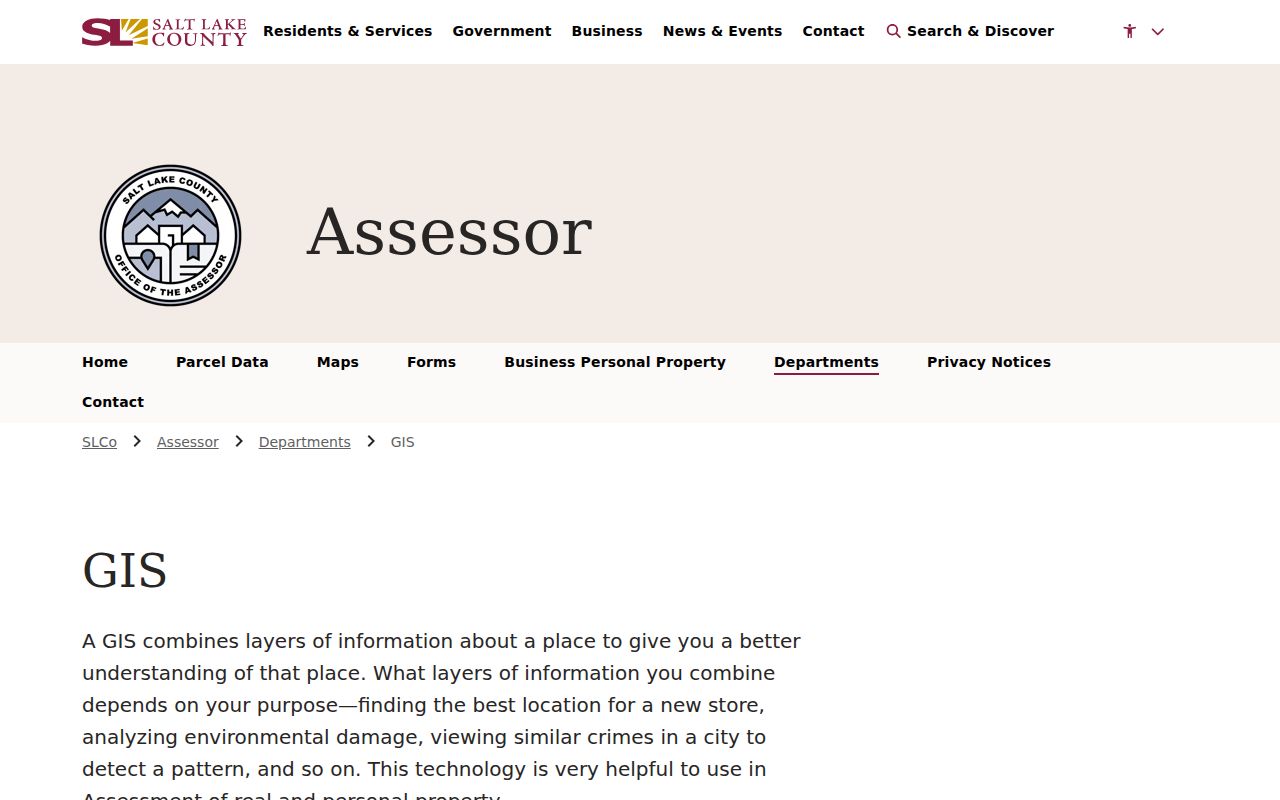
The screen is useful for mapped context, but the recorded instrument controls legal title. Utah is also a nondisclosure state, so assessor values must not be presented as verified sale-price history.
Taylorsville Public Records Offices
Office contact matters when the portal lacks a year, an image, or a reliable name match. County counters are at the Salt Lake County Government Center rather than in Taylorsville. The city recorder remains the right contact for ordinary municipal files, while court clerks handle judicial copies under court rules. Weekday hours below come from the researched office listings.
Taylorsville City Recorder
2600 W. Taylorsville Boulevard
Taylorsville, UT 84129
801-955-2006
Salt Lake County Recorder
2001 S. State Street, Suite N1-600
Salt Lake City, UT 84190
385-468-8145
Weekdays, 8 a.m. to 5 p.m.
Salt Lake County Assessor
County property and valuation records
385-468-8000
assessor@saltlakecounty.gov
Taylorsville Justice Court
8040 S. Redwood Road
West Jordan, UT 84088
801-963-0268
Weekdays, 8 a.m. to 5 p.m.
County Archives is an appointment-only fallback for superseded series. Its holdings include land-title certificates from 1851 to 1895, tax and property ledgers from 1853 to 2021, appraisal cards from 1934 to 1987, and building-permit cards extending into the modern era. High-volume archive inquiries may take 15 business days.
Taylorsville Court Records Channels
Taylorsville Justice Court hears city infractions, Class B and C misdemeanors, and small claims up to $15,000. Third District Court handles felony, major civil, family, and probate matters for Salt Lake County. Utah Courts Xchange is the paid public docket route for district and justice cases. MyCase is free, but only for a registered user's own eligible cases.
Xchange searches can be narrowed by jurisdiction, case number, party surname or company, first name, case type, court scope, and date. Broad results stop at 500, so common names need a court, case type, or date range. Complete Salt Lake City District coverage starts December 8, 1997; West Jordan District opened in June 2005 with converted data. Public electronic district documents filed since July 1, 2010 are available, while older converted files can be incomplete.
Free terminals at most district courthouses and the Utah State Law Library are the offline fallback. A written request should name the court, parties, case number if known, approximate year, and exact document. It should also state whether inspection, a plain copy, certification, or exemplification is needed. Files more than 50 years old may have moved to Utah Archives.
Note: An open docket can coexist with sealed images, redacted identifiers, or a document available only from the holding court.
West Jordan Holds Taylorsville Cases
The local court has a geographic quirk. Taylorsville Justice Court still serves Taylorsville, but its counter moved to the Thomas M. Rees Justice Center at 8040 S. Redwood Road in West Jordan. The move changed the physical custody location, not the court's city identity or jurisdiction. A searcher who goes only by the word “Taylorsville” can otherwise miss the correct counter.
The justice clerk can be reached at 801-963-0268 or jctaylorsville@utcourts.gov. Filing documents may be sent by email, but payments are not accepted by phone. West Jordan District Court is nearby at the same judicial hub and has a separate clerk. That distinction helps route a city misdemeanor or small claim to Justice Court and a felony, probate, or major civil matter to Third District Court.
Taylorsville Vital Records Limits
Current birth and death certificates are not open name indexes. The Utah Office of Vital Records and Statistics requires the correct application, acceptable identification, proof of relationship or authority, and the current fee. Eligible local applicants may also use Salt Lake County Health for birth or death service. The County Clerk handles marriage-license material, while a divorce decree comes from Third District Court.
Utah Archives opens births after 100 years and deaths after 50 years. A historical index does not make a recent certified certificate public. Older genealogy may require an archive index, obituary, cemetery record, church source, census, or probate file, especially before statewide civil registration. GRAMA cannot bypass certificate eligibility.
As of July 1, 2026, the researched state schedule lists an initial certified birth copy at $25, death at $35, and a marriage or divorce abstract at $25. Additional copies of the same record cost $10. State notices in June 2026 reported roughly six-week online and mail delays, so current timing should be checked before ordering.
Taylorsville Probate Records Offline
Probate is both a court record and a deep archive trail. Utah Archives' digitized Salt Lake probate index lists a year, individual name, probate case number, and estate register book and page. The volumes are browsable, not reliably full-text name searchable, so spelling variants and page-by-page review may be needed.
The official probate collection pictured here provides access to those digitized register and index volumes.
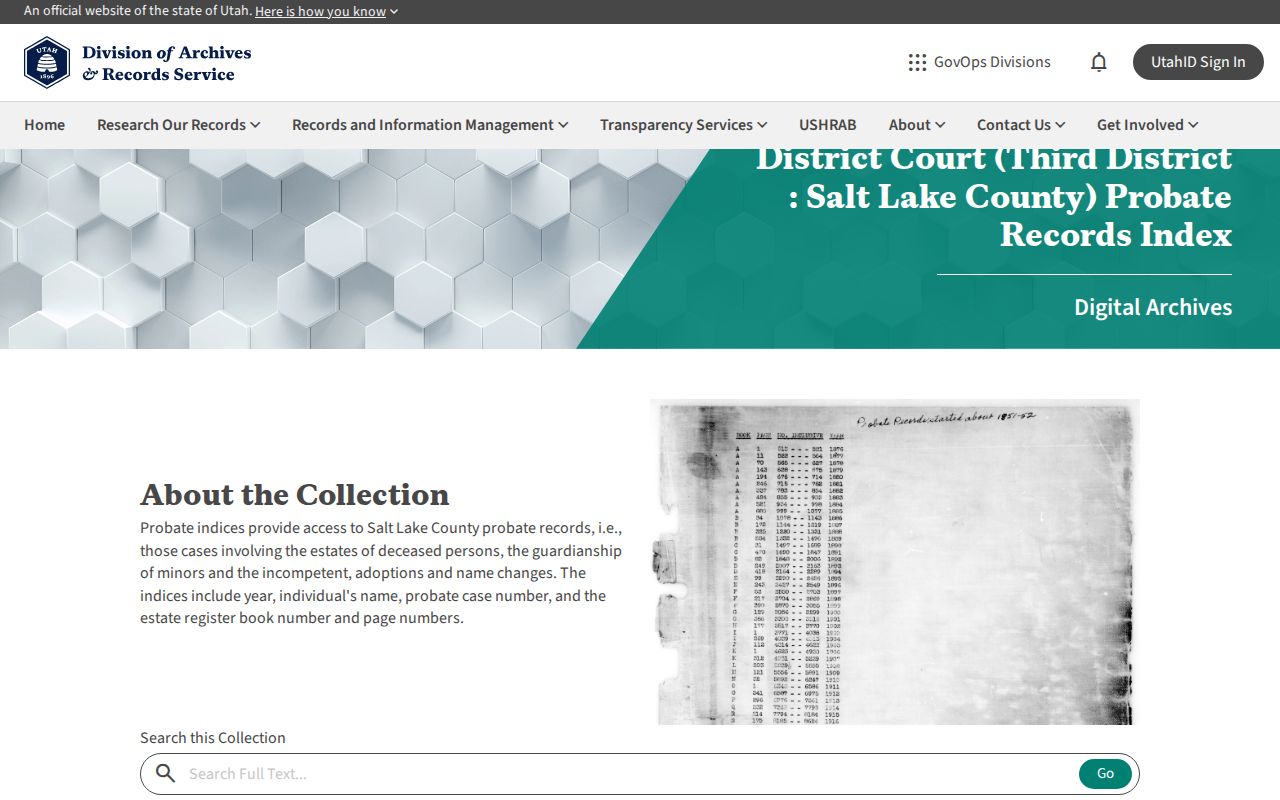
The image shows why an archive browse differs from a modern surname form. Once a case or register number is found, the court or Archives can route the underlying file. Probate material may connect a decedent, heirs, guardians, addresses, and estate property, but adoption records remain sealed for 100 years.
Taylorsville Custody Record Lookups
Custody information is split by agency. Salt Lake County Sheriff's jail docket covers current county jail activity. The Utah Department of Corrections Offender Search covers state prison, probation, and parole subjects. The state Sex and Kidnap Offender Registry is a separate statutory registry, while federal custody uses the Bureau of Prisons locator.
The Utah Corrections entry page shown here is the official state-level starting point.
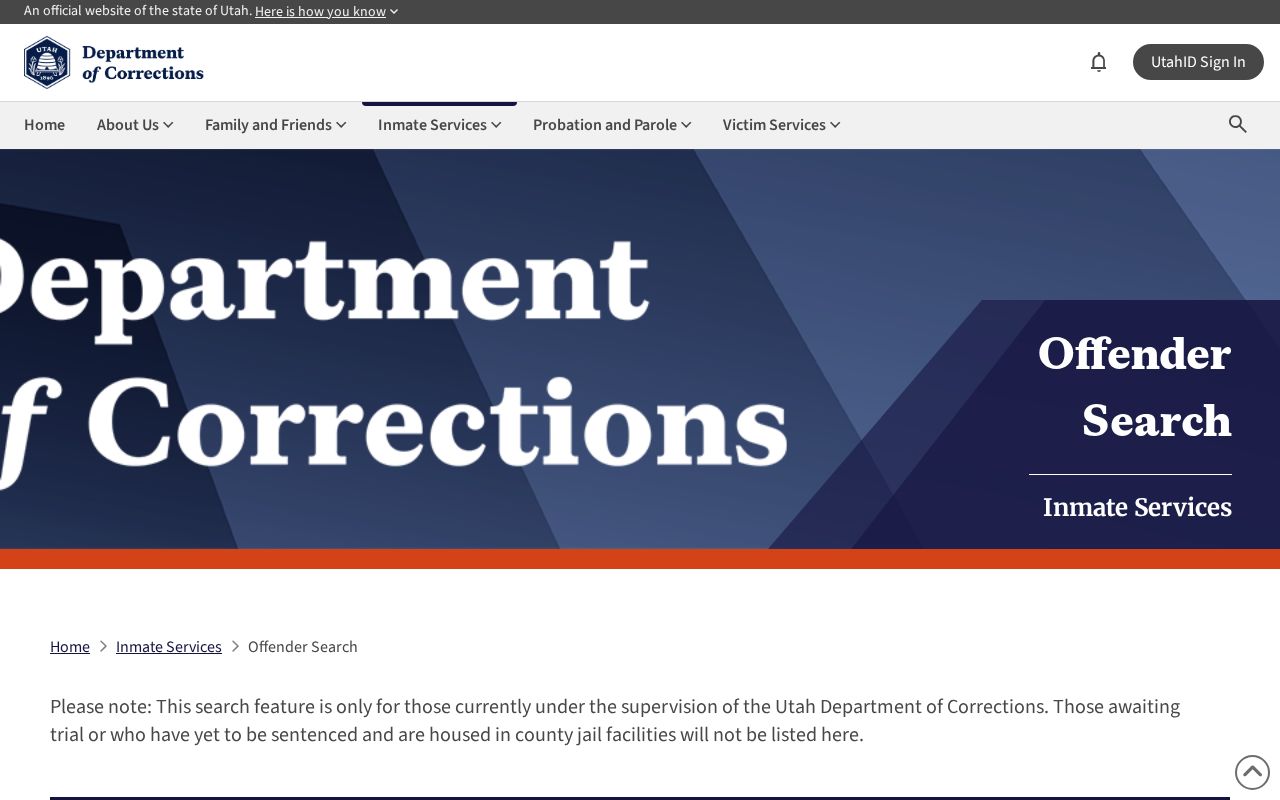
A corrections result may show an offender number, aliases, photograph, custody or supervision status, and sentence information. It does not cover every county booking. Names can collide, so sheriff, case, registry, or offender numbers should be used to test identity. An absent result in one system says nothing conclusive about the others.
Use records lawfully. Public access never permits threats, surveillance, repeated unwanted contact, stalking, or harassment. Follow each registry's stated public-safety limits and report an immediate threat to police.
Taylorsville Records Fee Types
A portal charge does not always buy a certified record. The recorder's $5 pass buys limited Data Services access, while its copy and certification schedule is separate. Xchange starts one-time users with $10 in account funding, then charges $0.20 per search and $1 per document. Most district courthouses and the State Law Library provide free terminals for public inspection.
Utah judicial copy fees also vary by output. The researched schedule lists paper at $0.25 per sheet, email or fax at $5 for up to ten pages plus $0.50 for each additional page, and a certified copy at $4 per document plus $0.50 per page. The first 15 minutes of staff time are free. GRAMA fees may cover actual duplication and direct search or retrieval work, with the first quarter-hour ordinarily excluded from staff-time charges.
Ask for an estimate and name a fee ceiling. A waiver may be requested when release primarily benefits the public, the requester is the subject, or the request directly affects the requester's legal rights. Whether a waiver applies is decided by the responding entity under Utah law.
Request Taylorsville Public Records
GRAMA, Utah Code Title 63G Chapter 2, allows any person to request an agency's open files. The normal response track is ten business days. An agency may provide the record, deny it with reasons and appeal information, or cite an extraordinary circumstance and give an estimated response date. A short, exact request lowers the risk of delay and excess search fees.
- Choose the custodian. Send municipal administration to the city, police material to the separate TVPD intake, county land files to the relevant county office, and court documents to Utah Courts.
- Check ordinary access first. Use the office's index, counter, or certificate application when one exists. GRAMA is not a substitute for a court form, a vital-record application, or an open-ended title search.
- Describe a searchable set. Give names, date span, department, and an incident, parcel, address, case, license, or document number. State whether inspection, electronic delivery, plain copies, or certification is wanted.
- Set the cost terms. Ask for an estimate, state a maximum without approval, and give a supported waiver reason when applicable. Keep the submission and response dates.
- Read any denial closely. Check the cited classification, redactions, and appeal instructions. A GRAMA denial can move first to the chief administrative officer, then through the routes allowed by Utah law.
Taylorsville's request form works best with a defined department and event. Salt Lake County NextRequest is the fallback for a county file not supplied through its ordinary portal. For courts, use the Judiciary Request for Record form. For a current certificate, use the record-specific application and include ID and relationship proof.
Taylorsville Records Withheld by Law
Utah access rules protect more than sealed court files. Current vital certificates, adoption and juvenile material, controlled health data, open-investigation details, protected victims, and certain identifiers can be closed or redacted. The Utah Address Confidentiality Program supplies a substitute address and mail forwarding to qualifying survivors. It protects new public-facing records but does not rewrite every old deed or docket.
Voter information has its own 2026 At-Risk rules. Nonprotected voter fields and data products are governed by election law, while At-Risk information is withheld. The full voter-record procedure belongs with the Taylorsville voter registration search, not a general GRAMA request. Commercial opt-outs likewise do not delete the source record held by a recorder, court, or agency.
When a public document contains an error or exposes data that may qualify for protection, contact the custodian and cite the record, field, and applicable program or statute. A missing web result can mean a spelling mismatch, archival transfer, sealed status, limited index coverage, or a portal design choice. It should not be treated as proof that the underlying event never occurred.